How many drops of essential oil in a diffuser?

How many drops of essential oil should go into a diffuser, and does adding more make the scent stronger?

Last reviewed

A small amber dropper bottle and a ceramic cup on an oak tray on a sideboard in a calm living room

Three to five drops per 100 ml of water in an ultrasonic diffuser, two or three in the dish of a tealight warmer. Adding more does not make the scent stronger for you — your nose stops registering a constant smell within minutes, no matter how much is in the tank. It only puts more oil into the room.

The dose, by tank size

A drop from a standard orifice reducer — the plastic insert in the neck of a 10 ml bottle — is about 0.05 ml, which is where the familiar "20 drops to a milliliter" comes from. That is the unit everything below is counted in.

Device · Water · Drops

  • Small ultrasonic diffuser — 100 ml — 3–5
  • Larger ultrasonic diffuser or mist humidifier — 150 ml — 5–7
  • Tealight warmer — a dish, not a tank — 2–3
  • A room you want barely scented — any — 2

Five drops in a 100 ml tank is a quarter of a milliliter of oil in a hundred milliliters of water. That is the whole dose, and it is enough for a normal room.

Why more is not stronger — the part with numbers

This is the question underneath the question. People add drops because after twenty minutes the room does not smell of anything any more, and they conclude the dose was too small. It was not. The room still smells. You stopped being able to tell.

Olfactory adaptation is fast and it is measured. In work correlating physiological and psychological responses to odor, conscious perception of a constant smell shuts down with a time constant of about 2.5 seconds, while the underlying physiological response falls by roughly half over 4 to 10 seconds, faster at higher concentrations. Longer-term habituation, over minutes, happens in the olfactory bulb itself.

Read that back and the practical consequence is blunt: the stronger the dose, the faster your nose stops noticing it. Doubling the drops does not double what you perceive. It doubles what is in the air, which is a different thing entirely — and what is in the air is the part that matters for anyone else in the room, for pets, and for the particulate discussed in are diffusers bad for you.

Visitors, incidentally, will smell what you cannot. If someone walks in and says the room smells strong, believe them over your own nose.

What actually changes the intensity

Since drops mostly do not, here is what does:

  1. Run time in bursts, not continuously. Thirty to sixty minutes on, then off. Coming back to a scent you have not been sitting in is the only way to perceive it as strong again — that is what recovery from habituation means.
  2. Room size and door position. A closed bedroom holds scent; an open-plan room dilutes it. Same drops, different result, and this is the variable people almost never adjust.
  3. The note itself. Citrus and mint read as bright and disappear quickly; cedar, patchouli and vanilla sit lower and last. If a scent feels weak, the family may be wrong for the job rather than the dose.
  4. How fresh the oil is. An oxidized bottle is weaker, and it smells sharp rather than faint — the difference is described in shelf life by note family.

Things worth not doing

  • Do not fill past the max line to fit more oil. Ultrasonic units are calibrated to a water level; over-filling makes them spit or cut out.
  • Do not put oil in without water in an ultrasonic device. The disc needs liquid to work against, and neat oil on it is how discs die.
  • Do not chase the smell with more drops through the evening. That is adaptation talking, and it ends with a room that is genuinely over-scented to everyone but you.
  • Do not scale the dose to the price of the bottle. A 10 ml bottle at five drops a session is around forty sessions; the temptation to "use it up" is what puts eight drops in a small bedroom.

What this looks like with ours

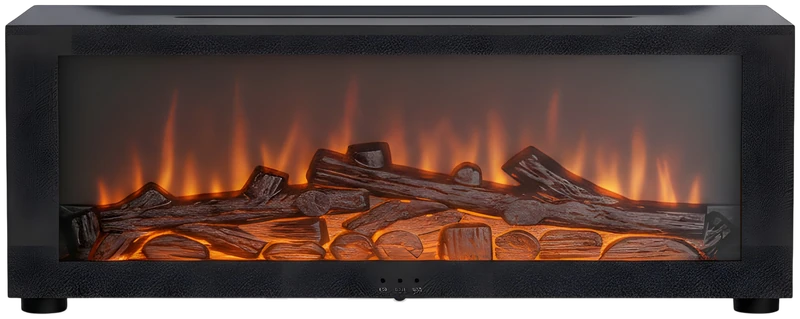
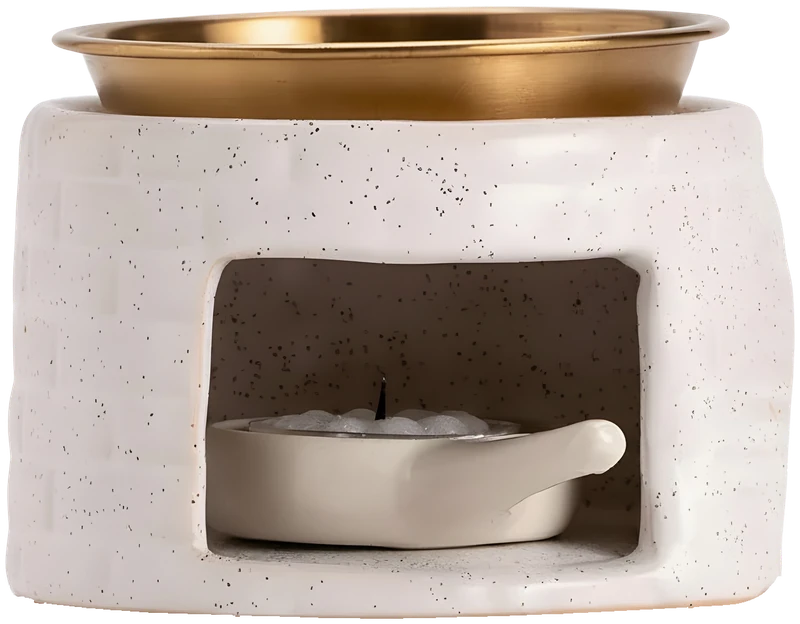
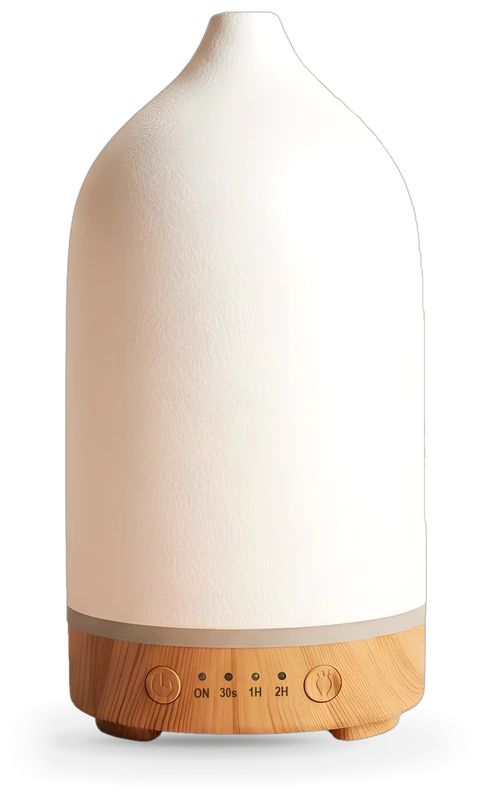
The Wood-Grain Aroma Diffuser holds 200 ml — seven to ten drops for a full tank, three to five if you fill it halfway. The Flame Mist Humidifier Diffuser holds 150 ml, so five to seven, though it earns its keep more as a humidifier than as a scent device. The ceramic and wooden warmers take two or three drops into water in the dish, and being flame-driven they release scent more slowly, which is a feature rather than a shortfall.

Every single note doses the same way — the numbers above are about the device and your nose, not about the plant.

Read next

Questions people ask next

How many drops of essential oil in a 100 ml diffuser?

Three to five. That is about a quarter of a milliliter of oil, using the standard measure of roughly twenty drops per milliliter from a bottle's orifice reducer. Five is a full room; two is a room you want barely scented.

How many drops for a 150 ml or 200 ml diffuser?

Scale it: five to seven drops for 150 ml, seven to ten for 200 ml. The ratio matters more than the absolute number — three to five drops per 100 ml of water.

Why can't I smell my diffuser after a few minutes?

Because your nose adapts, not because the diffuser stopped. Conscious perception of a constant odor shuts down with a time constant of around 2.5 seconds, and the physiological response halves within about four to ten seconds. The room still smells; you have simply stopped registering it. Anyone walking in will notice immediately.

Does adding more drops make the scent stronger?

Not to you, and not for long — a stronger dose adapts your nose faster. It does put more oil into the air, which matters for other people in the room, for pets, and for how much particulate the device is aerosolizing. Run it in bursts instead.

How many drops in a tealight oil warmer?

Two or three, into the water in the dish. A warmer releases scent more slowly than an ultrasonic diffuser, so it needs less rather than more.

Can I put essential oil in a diffuser without water?

No, not in an ultrasonic one. The vibrating disc works against liquid, and running neat oil on it damages the disc and voids most warranties. Water first, then the drops.

Where these numbers come from

  • The correlation between physiological and psychological responses to odour stimulation in human subjects (PubMed 11955999) — conscious perception shuts down with a time constant of ~2.5 s; physiological response declines ~50 % with a time course of 4–10 s, faster at higher odorant concentration
  • Repeated exposure to odors induces affective habituation of perception and sniffing (PMC3989720 / PubMed 24782728) — habituation of perception under repeated exposure
  • Olfactory bulb habituation to odor stimuli (PubMed 20695648) — longer-term habituation over minutes localised to the olfactory bulb
  • Drop volume of ~0.05 ml (about 20 drops per ml) is the standard figure for an essential-oil orifice reducer and is stated here as a convention, not a measurement of our own bottles
  • Tank capacities from our own catalogue listings, 2026-08-16
How we research and check these numbers