
Partly. Inhaled essential oils show small, real improvements in self-reported sleep and anxiety across several meta-analyses, and the reviewers who found those effects also describe the underlying trials as low quality and inconsistent. Nothing credible supports aromatherapy treating disease. Treat it as mood and routine, measured on questionnaires, not as medicine.
Every guide in this section
-
 Which essential oils blend well togetherHow do you combine essential oils so the result smells composed rather than muddled?→
 -
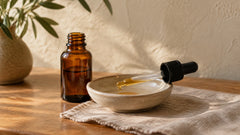 How long essential oils last, by note familyWhen does an essential oil go off, and how do I tell before I diffuse it?→
 -
 How many drops of essential oil in a diffuser?How many drops of essential oil should go into a diffuser, and does adding more make the scent stronger?→
Questions people ask next
Is aromatherapy scientifically proven?
Partly, and only for narrow outcomes. Meta-analyses of inhaled essential oils find small-to-moderate improvements in self-reported sleep and anxiety, while describing the trials behind them as low quality. There is no credible evidence that aromatherapy treats disease.
Is it just placebo?
Probably not entirely, and it is hard to prove either way. You cannot blind someone to a smell, so expectation is baked into every trial. What survives that problem is a consistent direction of effect across many small studies.
Which oil is best for anxiety?
Lavender has the most trials behind it, which is not the same as being best for you. Reviews of aromatherapy for anxiety report improvements on rating scales with the same caveats about trial quality that apply to sleep.
How many drops should I use?
Three to five in an ultrasonic diffuser is a full room. In a tealight warmer, two or three into the water in the dish. More is not stronger for long — the nose stops registering a constant scent within about twenty minutes.
Do essential oils expire?
They degrade rather than spoil, mostly through oxidation. Three years is the shelf life most bottlers print on the label. Cap closed, out of sunlight, and amber glass does the rest.
Where these numbers come from
- The Sleep-Enhancing Effect of Lavender Essential Oil in Adults, systematic review and meta-analysis (PubMed 40600743) — pooled SMD approximately −0.56
- Effects of aromatherapy on sleep quality in older adults, meta-analysis (PMC11630975) — pooled SMD approximately −1.02
- Systematic literature review and meta-analysis of aroma inhalation therapy on sleep problems (PMC7939222) — authors' own assessment of evidence quality
- NCCIH, Anxiety and Complementary Health Approaches — summary of the evidence base for inhaled aromatherapy
- Shelf-life figures stated by essential-oil bottlers on their own labels — typically three years