
Between 20 and 24 °C (68–75 °F) is where measured sleep efficiency peaks, and it drops five to ten percent for every five degrees above that. Keep relative humidity in the 30–50 percent band the EPA advises for a house. The pairing to avoid is warm and damp together — that combination costs more sleep than either does alone.
Questions people ask next
What is the best bedroom temperature for sleep?
Between 20 and 24 °C (68–75 °F). Measured sleep efficiency is highest in that band and falls by roughly five to ten percent for every five degrees above it. In older adults, nights above 24 °C are linked to autonomic disruption and higher heart rate.
What humidity should a bedroom be?
Between 30 and 50 percent, the range the EPA gives for indoor air. Below that the air dries out your nose and throat; above about 60 percent surfaces stay damp long enough to grow mold.
Does a humidifier help you sleep?
In a dry, heated bedroom, yes — moving a winter room from 20–30 percent toward 40 makes it noticeably less harsh. In a warm, humid room it does the opposite: humid heat is measurably worse for sleep than dry heat, because sweat stops evaporating. Check with a hygrometer before adding moisture.
Is it better to sleep in a cold room or a warm room?
Cooler, within reason. The efficiency curve peaks at 20–24 °C and falls off above it faster than below. A cold room costs you comfort; a hot room costs you measured sleep.
Does humidity affect sleep quality?
Mostly through temperature. Studies of humid heat find more wakefulness and lower sleep efficiency than the same warmth in dry air. In a cool room, humidity within the normal band has far less effect.
Should I use a diffuser or a humidifier in the bedroom?
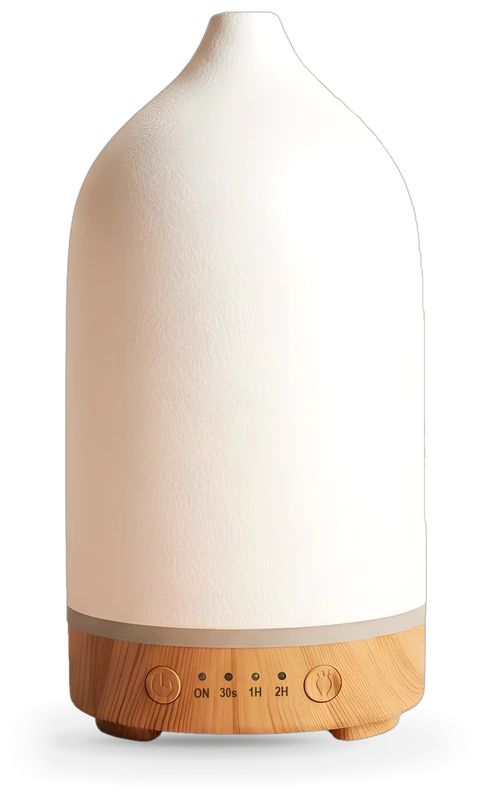
They are the same machine doing different jobs — a diffuser scents, a humidifier moistens, and an ultrasonic unit can do both. Decide by what the room needs: dry winter air wants moisture, a warm damp room wants neither, and scent is worth adding only once temperature and darkness are handled.
Where these numbers come from
- Nighttime ambient temperature and sleep in community-dwelling older adults (PubMed 37474050) — sleep efficiency highest at 20–25 °C; 5–10 % decline per 5 °C above the range
- Effect of nighttime bedroom temperature on heart rate variability in older adults (PMC12751657) — temperatures above 24 °C associated with autonomic disruption and higher heart rate
- Effects of humid heat exposure on human sleep stages and body temperature (PubMed 10505822) and Effects of partial humid heat exposure during different segments of sleep (PubMed 15639161) — humid heat increases wakefulness and lowers sleep efficiency versus dry heat
- US EPA, A Brief Guide to Mold, Moisture and Your Home — indoor relative humidity below 60 %, ideally 30–50 %
- Humidity rise from a 150 ml tank is our own arithmetic, set out in full in the mold guide, and stated there as an estimate rather than a measurement