Essential oils for sleep, and how far the evidence goes

Which essential oils help with sleep, and how much do they actually do?

Last reviewed

An oak nightstand with a glass of water, a book and a glowing table lamp beside a made bed

Lavender has the most clinical support and the effect is modest: meta-analyses find a small-to-moderate improvement in self-reported sleep quality, on trials the reviewers themselves call low quality. Chamomile, cedarwood and sandalwood are used the same way with less evidence. Three to five drops, half an hour before bed.

Start with what is actually established

Lavender is the only note in this category with a real body of clinical work behind it. A 2025 systematic review and meta-analysis of inhaled lavender in adults found a pooled improvement in sleep quality of roughly −0.56 standardized mean difference. A separate meta-analysis in older adults found a larger pooled effect, around −1.02.

Those are genuine results on a legitimate outcome — how rested people say they feel. They are also drawn from small trials with weak blinding, which the reviewers say plainly. You cannot blind a person to a smell, so expectation is inside every one of these numbers.

The fair summary: real, modest, and partly the ritual rather than the molecule. That is still worth something — a cue you repeat every night is most of what a bedtime routine is.

The notes people actually use, and why

  • Lavender — the default, and the one with the trials. Start here if you are starting anywhere.
  • Chamomile — softer and drier than lavender, and the usual second choice for people who find lavender soapy.
  • Cedarwood and Sandalwood — wood notes read as heavy and settled rather than floral. Good for people who dislike anything that smells like laundry.
  • Bergamot — a citrus that behaves unlike the others; used for winding down rather than waking up.
  • Vetiver and Frankincense — earth and resin, the heaviest end. A little goes a long way.

Buy them as single notes at 10 ml, which matters here more than anywhere: you cannot learn which one works on you from a blend someone else mixed.

Dose and timing, which matter more than the note

Three to five drops in an ultrasonic diffuser is a full room. Two hours before sleep, or half an hour, rather than all night — the nose adapts to a constant scent within about twenty minutes, so an all-night run mostly means refilling the tank.

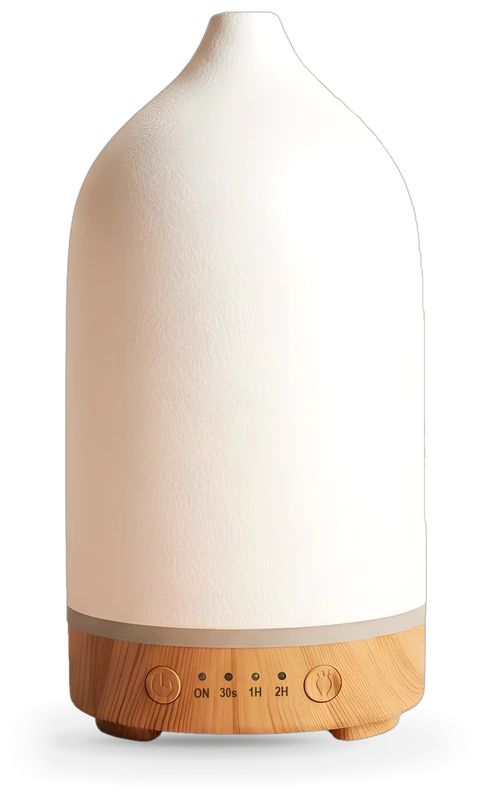
The Wood-Grain Aroma Diffuser runs on a timer of up to two hours, which is exactly this.

What this will not do

It will not treat insomnia, sleep apnea, or a body clock wrecked by shift work. If you are not sleeping at all, the thing to change is not a bottle of oil, and no honest shop should tell you otherwise. Light is a bigger lever than scent, and the order of what to change is in the sleep guide.

Before you run one in a bedroom with an animal in it

Cats are the constraint. Several notes used for sleep — eucalyptus, peppermint and the citrus family — are on the ASPCA's list of oils known to poison cats, and an ultrasonic diffuser puts real droplets into the air.

Lavender needs its own warning, because the usual advice gets it wrong. The ASPCA's essential-oils article does not name lavender, but the ASPCA's toxic plant database lists it as toxic to cats and dogs, with linalool and linalyl acetate as the toxic principles. The note with the best sleep evidence for people is therefore not the safe default for a shared bedroom. The cat guide explains where the two lists diverge.

Questions people ask next

Which essential oil is best for sleep?

Lavender, on the evidence rather than on taste. It has the most trials behind it, with meta-analyses reporting a small-to-moderate improvement in self-reported sleep quality. Chamomile, cedarwood and sandalwood are used the same way with far less clinical support.

How many drops of lavender should I use?

Three to five in an ultrasonic diffuser, two or three in a tealight warmer. More is not stronger for long, because the nose stops registering a constant scent within about twenty minutes.

Should the diffuser run all night?

It does not need to. Half an hour to two hours before sleep does the same work. All-night running mostly means refilling the tank more often.

Do essential oils actually make you sleep, or is it placebo?

Probably some of both, and it is hard to separate — you cannot blind someone to a smell. What survives that problem is a consistent direction of effect across many small studies, on questionnaire outcomes rather than laboratory ones.

Is lavender safe to diffuse around a cat?

We treat it as one to avoid. The ASPCA's essential-oils article does not name lavender, but its toxic plant database lists Lavandula angustifolia as toxic to cats and dogs, with linalool and linalyl acetate as the toxic principles. If a cat shares the room, pick chamomile, cedarwood or sandalwood instead.

Where these numbers come from

  • The Sleep-Enhancing Effect of Lavender Essential Oil in Adults, systematic review and meta-analysis (PubMed 40600743) — pooled SMD approximately −0.56
  • Effects of aromatherapy on sleep quality in older adults, meta-analysis (PMC11630975) — pooled SMD approximately −1.02
  • Systematic literature review and meta-analysis of aroma inhalation therapy on sleep problems (PMC7939222) — reviewers' own assessment of trial quality
  • ASPCA Animal Poison Control — oils known to cause poisoning in cats, including citrus, peppermint and eucalyptus
  • ASPCA Toxic and Non-Toxic Plants database, Lavender (Lavandula angustifolia) — toxic to cats and dogs; toxic principles linalool and linalyl acetate
  • Weralis catalogue — 200 ml tank and a timer of up to two hours on the Wood-Grain Diffuser
How we research and check these numbers