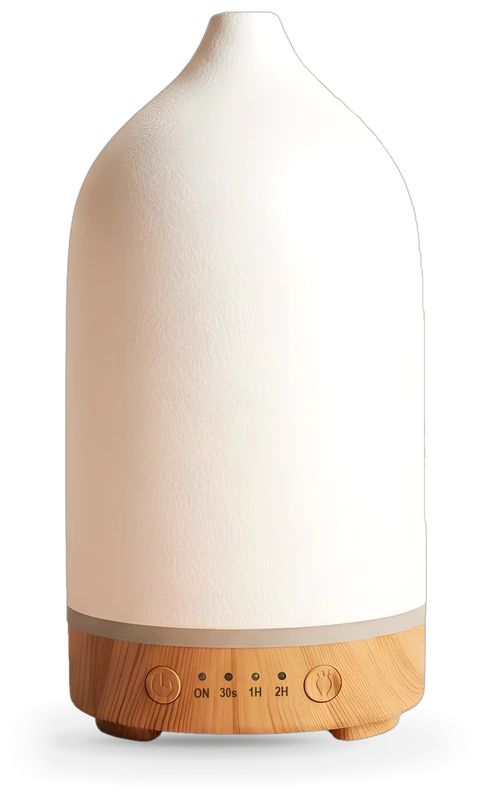

Cats lack an efficient version of the liver pathway that breaks these compounds down, so exposure accumulates. The ASPCA names wintergreen, sweet birch, citrus, pine, ylang ylang, peppermint, cinnamon, pennyroyal, clove, eucalyptus and tea tree as oils known to poison cats. Twelve of the notes people commonly diffuse are on that list.
Questions people ask next
Which essential oils are safe for cats?
Safest is a short list rather than a long one: chamomile, cedarwood, sandalwood, frankincense and vetiver are on neither ASPCA list. Note that this is not a guarantee of harmlessness — it means they are not named, so ventilation, short runs and an escape route still apply. Lavender is not on this list, and the reason is explained above.
Which essential oils are toxic to cats?
The ASPCA names wintergreen, sweet birch, citrus (d-limonene), pine, ylang ylang, peppermint, cinnamon, pennyroyal, clove, eucalyptus and tea tree. Twelve of the notes people commonly diffuse fall on that list and we say which.
Can I use an ultrasonic diffuser if I have a cat?
Only with conditions: a room the cat can leave, a set period rather than continuous running, and a note that is not on the list. Ultrasonic devices emit real droplets that settle on fur, and the cat then grooms them off — inhalation is not the only route.
Is a reed diffuser or a warmer safer for cats?
For inhalation, yes — passive devices release no droplets. They introduce a different problem: an open flame and a reachable dish of warm oil.
Is lavender safe to diffuse around cats?
We treat it as one to avoid, and the confusion is genuine. The ASPCA's essential-oils article does not name lavender; the ASPCA's toxic plant database does list Lavandula angustifolia as toxic to cats, with linalool and linalyl acetate as the toxic principles. Two ASPCA pages, two different questions. We follow the stricter one.
What do I do if my cat is exposed?
Move it to fresh air, do not wash with anything oily, and call your vet or the ASPCA Animal Poison Control Center on (888) 426-4435. Watch for drooling, vomiting, wobbliness, watery eyes or nose, and labored breathing.
Where these numbers come from
- ASPCA Animal Poison Control — oils known to cause poisoning in cats; passive versus active diffuser distinction; APCC hotline (888) 426-4435
- ASPCA, The Essentials of Essential Oils Around Pets — gastrointestinal upset, central nervous system depression and liver damage from significant exposure
- Texas A&M School of Veterinary Medicine, Pet Talk — essential oil diffusers and cats
- Pet Poison Helpline — essential oils and cats
- ASPCA Toxic and Non-Toxic Plants database, Lavender (Lavandula angustifolia) — toxic to cats, dogs and horses; toxic principles linalool and linalyl acetate
- Common household single notes counted one by one against the ASPCA essential-oils list