
Mostly no, and for dryness the opposite is often true. Around one in five people sleep with their eyelids slightly open, and eye doctors treat that with a mask, not without one. Styes come from blocked lid glands and bacteria, not from darkness. The two real risks are pressure on the eyelid and a mask you never clean.
Questions people ask next
Can sleeping in an eye mask cause dry eyes?
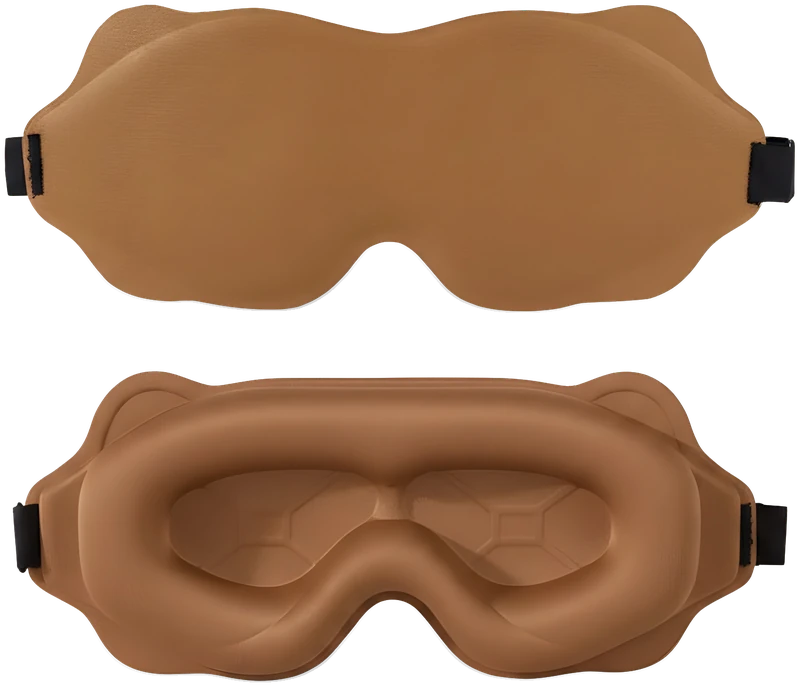
Only through pressure. Darkness does not affect the tear film, but a flat mask pulled tight rests on the eyelid and disturbs how it sits overnight. A molded mask leaves an empty cup over the eye, so nothing touches the lid.
Can a sleep mask cause a stye?
Not by itself. A stye is a blocked eyelid gland plus bacteria, and the main predisposing factor named in eye literature is blepharitis, chronic lid-margin inflammation. An unwashed mask can carry oil and bacteria back onto the lid margin, which makes it a route rather than a cause.
I wake up with dry, gritty eyes and I do not wear a mask. Why?
A frequent cause is nocturnal lagophthalmos, sleeping with the lids not fully closed — clinical sources put it at roughly one in five people. Eye specialists often manage it with a mask that keeps the lids closed or holds moisture, so in that situation a mask is the intervention, not the problem.
Is a contoured mask the right one for dry eyes?
For dryness caused by pressure, yes — the cups keep everything off the lid. For dryness caused by lids that do not fully close, no. That needs a mask designed to seal the lids or to hold a humid pocket, which a contoured mask is not.
How do I clean a contoured sleep mask?
Spot clean the edge that touches your face and air dry it completely. No machine wash.
Should I wear a mask if I already have a stye?
Leave it off until the eyelid has settled, and do not share a mask with anyone. Pressing fabric onto an inflamed lid margin nightly is not helpful, and a stye that is painful, spreading or affecting vision should be looked at by a clinician.
Where these numbers come from
- EyeWiki (American Academy of Ophthalmology) — Stye: external hordeolum from the glands of Zeis and Moll, internal hordeolum from the meibomian glands; blepharitis as the main predisposing factor, higher incidence alongside dry eye
- AllAboutVision — stye overview: staphylococcal bacteria in a blocked lid gland; daily lid hygiene with mild cleanser and warm water to reduce incidence
- Optometry Times, "Better manage nocturnal lagophthalmos for dry eye patients" — incomplete lid closure driving tear-film evaporation; fabric masks to keep lids closed and moisture-chamber masks for severe cases
- Nocturnal lagophthalmos: an overview and classification (PubMed 16671223); Nocturnal Lagophthalmos and Sleep Quality in Patients with Dry Eye Disease (PMC7399990) — prevalence and mechanism
- Weralis catalogue — Contoured shape with deep eye cups and hollow nose section, polyester, spot clean only